Fail:Sphere wireframe.svg
Mine navigeerimisribale
Mine otsikasti
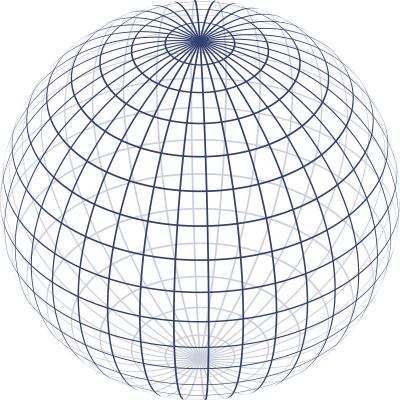
Selle SVG-faili PNG-vormingus eelvaate suurus: 400 × 400 pikslit. Teised eraldusvõimed: 240 × 240 pikslit | 480 × 480 pikslit | 768 × 768 pikslit | 1024 × 1024 pikslit | 2048 × 2048 pikslit.


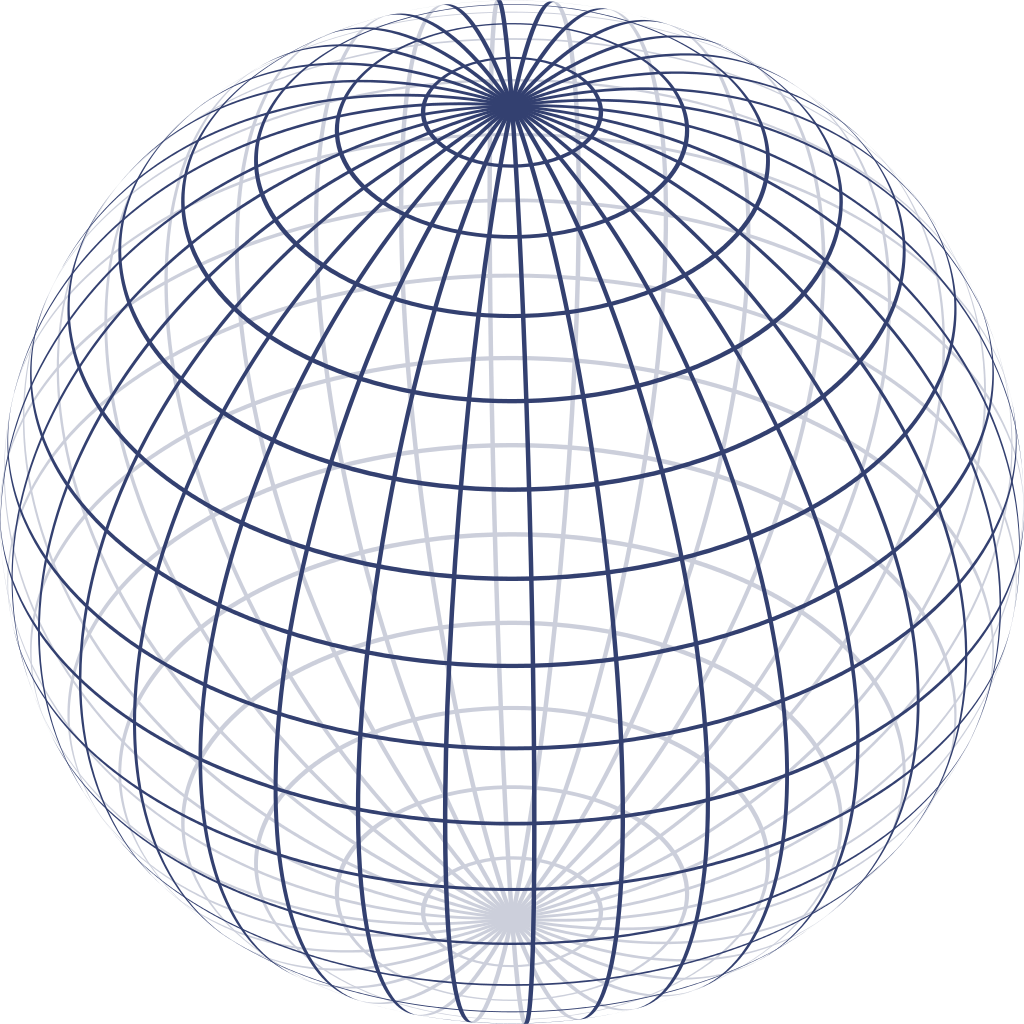
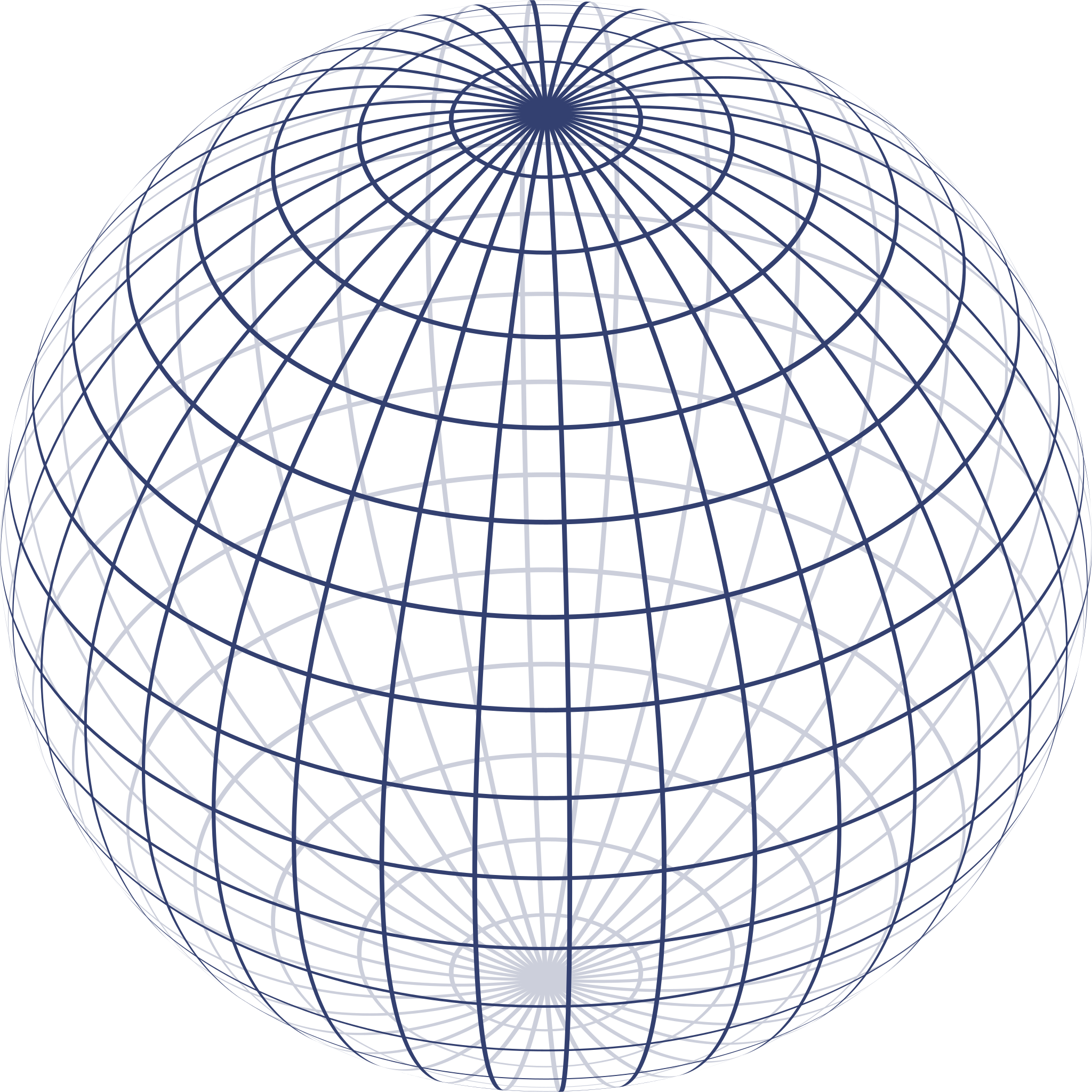
Algfail (SVG-fail, algsuurus 400 × 400 pikslit, faili suurus: 8 KB)

Lühikirjeldus
| Kirjeldus |
English: Sphere wireframe - orthogonal projection of a sphere. The image shows lines, which are drawn as they were painted onto the surface of a sphere. The angular distance between two lines is 10°. The SVG file is created by the below C++-program, which calculates each edge of a line as an ellipse-bow. The backside of the sphere has an opacity of 0.25. The axis tilt is 52.5°. |
| Kuupäev | |
| Allikas | Üleslaadija oma töö |
| Autor | Geek3 |
| Teised versioonid | Sphere wireframe 10deg 10r.svg |


 W3C-validity not checked.
Source Code
This image can be completely generated by the following source code. If you have the gnu compiler collection installed, the programm can be compiled by the following commands:
g++ sphere_wireframe.cpp -o sphere_wireframe
and run :
./sphere_wireframe > Sphere_wireframe.svg
It creates file Sphere_wireframe.svg in working directory. This file can be viewed using rsvg-view program :
rsvg-view Sphere_wireframe.svg
Here is cpp code in file : sphere_wireframe.cpp
/* sphere - creates a svg vector-graphics file which depicts a wireframe sphere
 *
 * Copyright (C) 2008 Wikimedia foundation
 *
 * This program is free software; you can redistribute it and/or modify
 * it under the terms of the GNU General Public License as published by
 * the Free Software Foundation; either version 2, or (at your option)
 * any later version.
 *
 * This program is distributed in the hope that it will be useful,
 * but WITHOUT ANY WARRANTY; without even the implied warranty of
 * MERCHANTABILITY or FITNESS FOR A PARTICULAR PURPOSE.  See the
 * GNU General Public License for more details.
 *
 * You should have received a copy of the GNU General Public License
 * along with this program; if not, you can either send email to this
 * program's author (see below) or write to:
 *   The Free Software Foundation, Inc.
 *   51 Franklin Street, Fifth Floor
 *   Boston, MA 02110-1301  USA
 */

/* The expressions in this code are not proven to be correct.
 * Hence this code probably contains lots of bugs. Be aware! */

#include <iostream>
#include <cmath>
#include <cstdlib>
#include <cstring>

using namespace std;

const double PI = 3.1415926535897932;
const double DEG = PI / 180.0;

/********************************* settings **********************************/
int n_lon = 18; 			// number of latitude fields (18 => 10° each)
int n_lat = 18; 			// half number of longitude fields (18 => 10° each)
double lon_offset = 2.5 * DEG; 	// offset of the meridians
double w = 52.5 * DEG; 		// axial tilt (0° => axis is perpendicular to image plane)
double stripe_grad = 0.5 * DEG;	// width of each line
int image_size = 400;			// width and height of the image in pixels
double back_opacity = 0.25;		// opacity of the sphere's backside
char color[] = "#334070";		// color of lines
int istep = 2; 			// svg code indentation step
/*****************************************************************************/

double sqr(double x)
{
	return(x * x);
}

// commands for svg-code:
void indent(int n, bool in_tag = false)
{
	n *= istep;
	if (in_tag) n += istep + 1;
	for (int i = 0; i < n; i++) cout << " ";
}
void M()
{
	cout << "M ";
}
void Z()
{
	cout << "Z ";
}
void xy(double x, double y)
{
	cout << x << ",";
	cout << y << " ";
}
void arc(double a, double b, double x_axis_rot, bool large_arc, bool sweep)
{	// draws an elliptic arc
	if (b < 0.5E-6)
	{	// flat ellipses are not rendered properly => use line
		cout << "L ";
	}
	else
	{
		cout << "A ";
		cout << a << ",";	// semi-major axis
		cout << b << " ";	// semi-minor axis
		cout << x_axis_rot << " ";
		cout << large_arc << " ";
		cout << sweep << " ";
	}
}
void circle(bool clockwise)
{
	M();
	xy(-1, 0);
	arc(1, 1, 0, 0, !clockwise);
	xy(1, 0);
	arc(1, 1, 0, 0, !clockwise);
	xy(-1, 0);
	Z();
}

void start_svg_file()
{
	cout << "<?xml version=\"1.0\" encoding=\"UTF-8\" standalone=\"no\"?>\n";
	cout << "<svg id=\"Sphere_wireframe\"\n";
	cout << "  version=\"1.1\"\n";
	cout << "  baseProfile=\"full\"\n";
	cout << "  xmlns=\"http://www.w3.org/2000/svg\"\n";
	cout << "  xmlns:xlink=\"http://www.w3.org/1999/xlink\"\n";
	cout << "  width=\"" << image_size << "\"\n";
	cout << "  height=\"" << image_size << "\">\n\n";
	cout << "  <title>Sphere wireframe</title>\n\n";
	cout << "  <desc>\n";
	cout << "     about: http://commons.wikimedia.org/wiki/Image:Sphere_wireframe.svg\n";
	cout << "     rights: GNU Free Documentation license,\n";
	cout << "             Creative Commons Attribution ShareAlike license\n";
	cout << "  </desc>\n\n";
	cout << "  <g id=\"sphere\" transform=\"scale(" << 0.5 * image_size;
	cout << ", " << -0.5 * image_size << ") translate(1, -1)\">\n";
}

void end_svg_file()
{
	cout << "  </g>\n</svg>\n";
}


int main (int argc, char *argv[])
{
	// accept -lat and -lon as parameter
	for (int i = 2; i < argc; i++)
	{
		if (isdigit(argv[i][0]) || (sizeof(argv[i]) > sizeof(char)
			&& isdigit(argv[i][1])
			&& (argv[i][0] == '.' || argv[i][0] == '-')))
		{
			if (strcmp(argv[i - 1], "-lon") == 0)
			{
				lon_offset = atof(argv[i]) * DEG;
			}
			if (strcmp(argv[i - 1], "-lat") == 0)
			{
				w = atof(argv[i]) * DEG;
			}
		}
	}
	double cosw = cos(w), sinw = sin(w);
	double d = 0.5 * stripe_grad;

	start_svg_file();
	int ind = 2; // initial indentation level
	indent(ind);
	cout << "<g id=\"sphere_back\" transform=\"rotate(180)\" ";
	cout << "opacity=\"" << back_opacity << "\">\n";
	indent(++ind);
	cout << "<g id=\"sphere_half\">\n";

	// meridians
	indent(++ind); cout << "<g id=\"meridians\"\n";
	indent(ind++, true);
	cout << "style=\"stroke:none; fill:" << color << "; fill_rule:evenodd\">\n";
	double a = abs(cos(d));
	for (int i_lon = 0; i_lon < n_lat; i_lon++)
	{	// draw one meridian
		double longitude = lon_offset + (i_lon * 180.0 / n_lat) * DEG;
		double lon[2];
		lon[0] = longitude + d;
		lon[1] = longitude - d;

		indent(ind);
		cout << "<path id=\"meridian";
		cout << i_lon << "\"\n";
		indent(ind, true);
		cout << "d=\"";

		double axis_rot = atan2(-1.0 / tan(longitude), cosw);
		if (sinw < 0)
			axis_rot += PI;
		double w2 = sin(longitude) * sinw;
		double b = abs(w2 * cos(d));

		double sinw1 = sin(d) / sqrt(1.0 - sqr(sin(longitude) * sinw));

		if (abs(sinw1) >= 1.0)
		{	// stripe covers edge of the circle
			double w3 = sqrt(1.0 - sqr(w2)) * sin(d);
			circle(false);
			// ellipse
			M();
			xy(sin(axis_rot) * w3 - cos(axis_rot) * a,
				-cos(axis_rot) * w3 - sin(axis_rot) * a);
			arc(a, b, axis_rot / DEG, 0, 0);
			xy(sin(axis_rot) * w3 + cos(axis_rot) * a,
				-cos(axis_rot) * w3 + sin(axis_rot) * a);
			arc(a, b, axis_rot / DEG, 0, 0);
			xy(sin(axis_rot) * w3 - cos(axis_rot) * a,
				-cos(axis_rot) * w3 - sin(axis_rot) * a);
			Z();
		}
		else
		{	// draw a disrupted ellipse bow
			double w1 = asin(sinw1);
			M();
			xy(-cos(axis_rot + w1), -sin(axis_rot + w1));
			arc(a, b, axis_rot / DEG, 1, 0);
			xy(cos(axis_rot - w1), sin(axis_rot - w1));
			arc(1, 1, 0, 0, 1);
			xy(cos(axis_rot + w1), sin(axis_rot + w1));
			arc(a, b, axis_rot / DEG, 0, 1);
			xy(-cos(axis_rot - w1), -sin(axis_rot - w1));
			arc(1, 1, 0, 0, 1);
			xy(-cos(axis_rot + w1), -sin(axis_rot + w1));
		}
		Z();
		cout << "\" />\n";
	}
	indent(--ind); cout << "</g>\n";

	cout << endl;

	// circles of latitude
	indent(ind); cout << "<g id=\"circles_of_latitude\"\n";
	indent(ind, true);
	cout << "style=\"stroke:none; fill:" << color << "; fill_rule:evenodd\">\n";
	ind++;
	for (int i_lat = 1; i_lat < n_lon; i_lat++)
	{	// draw one circle of latitude
		double latitude = (i_lat * 180.0 / n_lon - 90.0) * DEG;
		double lat[2];
		lat[0] = latitude + d;
		lat[1] = latitude - d;
		double x[2], yd[2], ym[2];
		for (int i = 0; i < 2; i++)
		{
			x[i] = abs(cos(lat[i]));
			yd[i] = abs(cosw * cos(lat[i]));
			ym[i] = sinw * sin(lat[i]);
		}
		double h[4];	// height of each point above image plane
		h[0] = sin(lat[0] + w);
		h[1] = sin(lat[0] - w);
		h[2] = sin(lat[1] + w);
		h[3] = sin(lat[1] - w);

		if (h[0] > 0 || h[1] > 0 || h[2] > 0 || h[3] > 0)
		{	// at least any part visible
			indent(ind);
			cout << "<path id=\"circle_of_latitude";
			cout << i_lat << "\"\n";
			indent(ind, true);
			cout << "d=\"";
			for (int i = 0; i < 2; i++)
			{
				if ((h[2*i] >= 0 && h[2*i+1] >= 0)
					&& (h[2*i] > 0 || h[2*i+1] > 0))
				{	// complete ellipse
					M();
					xy(-x[i], ym[i]); // startpoint
					for (int z = 1; z > -2; z -= 2)
					{
						arc(x[i], yd[i], 0, 1, i);
						xy(z * x[i], ym[i]);
					}
					Z();
					if (h[2-2*i] * h[3-2*i] < 0)
					{	// partly ellipse + partly circle
						double yp = sin(lat[1-i]) / sinw;
						double xp = sqrt(1.0 - sqr(yp));
						if (sinw < 0)
						{
							xp = -xp;
						}
						M();
						xy(-xp, yp);
						arc(x[1-i], yd[1-i], 0,
							sin(lat[1-i]) * cosw > 0, cosw >= 0);
						xy(xp, yp);
						arc(1, 1, 0, 0, cosw >= 0);
						xy(-xp, yp);
						Z();
					}
					else if (h[2-2*i] <= 0 && h[3-2*i] <= 0)
					{	// stripe covers edge of the circle
						circle(cosw < 0);
					}
				}
			}

			if ((h[0] * h[1] < 0 && h[2] <= 0 && h[3] <= 0)
				|| (h[0] <= 0 && h[1] <= 0 && h[2] * h[3] < 0))
			{
				// one slice visible
				int i = h[0] <= 0 && h[1] <= 0;
				double yp = sin(lat[i]) / sinw;
				double xp = sqrt(1.0 - yp * yp);
				M();
				xy(-xp, yp);
				arc(x[i], yd[i], 0, sin(lat[i]) * cosw > 0, cosw * sinw >= 0);
				xy(xp, yp);
				arc(1, 1, 0, 0, cosw * sinw < 0);
				xy(-xp, yp);
				Z();
			}
			else if (h[0] * h[1] < 0 && h[2] * h[3] < 0)
			{
				// disrupted ellipse bow
				double xp[2], yp[2];
				for (int i = 0; i < 2; i++)
				{
					yp[i] = sin(lat[i]) / sinw;
					xp[i] = sqrt(1.0 - sqr(yp[i]));
					if (sinw < 0) xp[i] = -xp[i];
				}
				M();
				xy(-xp[0], yp[0]);
				arc(x[0], yd[0], 0, sin(lat[0]) * cosw > 0, cosw >= 0);
				xy(xp[0], yp[0]);
				arc(1, 1, 0, 0, 0);
				xy(xp[1], yp[1]);
				arc(x[1], yd[1], 0, sin(lat[1]) * cosw > 0, cosw < 0);
				xy(-xp[1], yp[1]);
				arc(1, 1, 0, 0, 0);
				xy(-xp[0], yp[0]);
				Z();
			}
			cout << "\" />\n";
		}
	}
	for (int i = 0; i < 3; i++)
	{
		indent(--ind);
		cout << "</g>\n";
	}
	indent(ind--);
	cout << "<use id=\"sphere_front\" xlink:href=\"#sphere_half\" />\n";
	end_svg_file();
}
Litsents
Autoriõiguse omanikuna avaldan selle teose järgmiste litsentside all:

|
Luba on antud selle dokumendi kopeerimiseks, avaldamiseks ja/või muutmiseks GNU Vaba Dokumentatsiooni Litsentsi versiooni 1.2 või hilisema Vaba Tarkvara Fondi avaldatud versiooni tingimuste alusel; muutumatute osadeta, esikaane tekstideta ja tagakaane tekstideta. Sellest loast on lisatud koopia leheküljel pealkirjaga "GNU Free Documentation License". |


See fail kuulub Creative Commonsi jurisdiktsiooniga sidumata litsentsi "Autorile viitamine + jagamine samadel tingimustel 3.0" ning üldise litsentsi "Autorile viitamine + jagamine samadel tingimustel" versioonide 2.5, 2.0 ja 1.0 alla.
- Tohid:
- jagada – teost kopeerida, levitada ja edastada
- kohandada – valmistada muudetud teoseid
- Järgmistel tingimustel:
- omistamine – Pead materjali sobival viisil autorile omistama, tooma ära litsentsi lingi ja märkima ära, kas on tehtud muudatusi. Sobib, kui teed seda mõistlikul viisil, kuid seejuures ei tohi jääda muljet, et litsentsiandja tõstab esile sind või seda, et sina materjali kasutad.
- sarnaselt jagamine – Kui töötled, kujundad ümber või arendad materjali edasi, siis pead oma töö levitamiseks kasutama sama litsentsi, mille all on algupärand, või ühilduvat litsentsi.
Sa võid valida endale sobiva litsentsi.
Faili ajalugu
Klõpsa kuupäeva ja kellaaega, et näha sel ajahetkel kasutusel olnud failiversiooni.
| Kuupäev/kellaaeg | Pisipilt | Mõõtmed | Kasutaja | Kommentaar | |
|---|---|---|---|---|---|
| viimane | 23. november 2008, kell 17:10 | | 400 × 400 (8 KB) | wikimediacommons>Geek3 | {{Information |Description={{en|1=Sphere wireframe - the image shows lines, which are drawn as they were painted onto the surface of a sphere. The distance between two lines is 10°. The svg file is created by the below c++-program, which calculates each |
Faili kasutus
Seda faili kasutab järgmine lehekülg:
